Who Are You When You Close Your Eyes?
“When I discover who I am, I’ll be free.”- Ralph Ellison
By Ania Atsu
What do you do when you’re not busy doing? When you step out of the roles—artist, collector, graphic designer, poet, founder, general manager, educator—who are you, really?
As autumn evenings grow longer, there’s an invitation here, one that many of us might miss in the rush of getting to the good stuff after a day’s hustle. But what is the good stuff, really? Who are you when stripped of appearance, status, and validation?
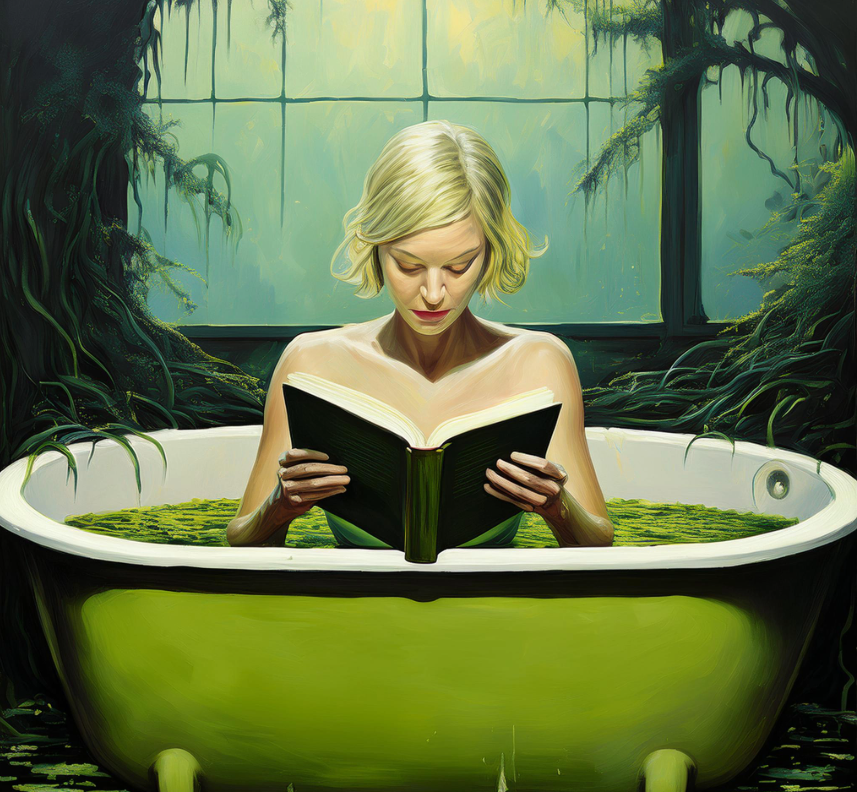
Welcome to my corner, where I freely explore what occupies my mind. It’s not just a place to boast about the luxurious home-prepared bath-in-algae sans watch-check (though that’s in here too); it’s a space for turning our gaze inward. I’ll throw some thought-provoking questions your way, with hints from literature, philosophy and discoveries from well-known classics as well as emerging modern art by young international artists, for a conversation less about what we make—and more about who we are when we’re quiet.

Ellison’s words, When I discover who I am, I’ll be free, encapsulate what we all long for, often unknowingly. Art, perhaps, brings us the closest to this sense of freedom. We don’t just paint, sculpt, or design for the approval of others. Ideally, our best work comes from a place of genuine self-expression, a channeling of the parts of ourselves that we don’t put on display (or we do!). The truest art happens when we step away from the performance and dig deeper into the stuff that stays with us in silence.
Who Shapes Your Values and Beliefs?
When we shut out the noise and visual stimuli, what’s left? Our thoughts, values, beliefs. But are these values really ours? Or are they remnants, gifts (or perhaps burdens) from the people around us? Reflecting on these quiet moments uncovers our core beliefs, the pillars that guide us—when we aren’t even aware. “Who am I without my routines and rituals?” is a question that can feel ghastly, and yet it’s exactly the one that leads us closest to the truth of who we are.
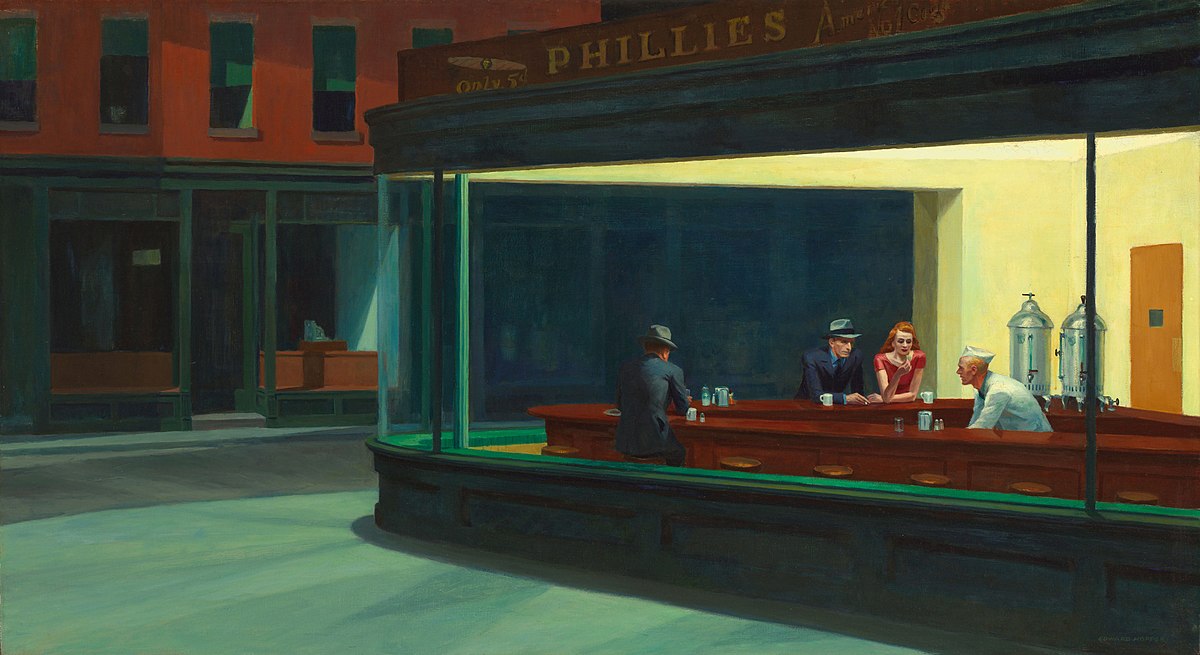
The painting Nighthawks by Edward Hopper is a haunting example of this isolation of self, where individuals sit together in silence, closed off yet connected by shared solitude. The composition places each figure in their own bubble, yet they share the same quiet space. It’s a visual echo of that introspective question: “Who are you, sitting there in your thoughts, beyond the surface-level identities?”
In an age where art is often seen as an avenue for prestige or profit, the wisdom of philosophers like Socrates reminds us of deeper values beyond material wealth accumulation. Socrates urged us to seek friendship, community, and virtue—foundations of a fulfilling life that transcend possessions. For artists, these ideals resonate deeply; the connections we build, the communities we form, and the virtues we aspire to reflect in our work are, perhaps, the truest markers of creative success. Art can become not just a medium for expression, but a catalyst for connecting with others and embodying the virtues that enrich human life.
Aristotle further developed this idea, emphasizing that true happiness lies in embodying goodness through virtues like justice, temperance, prudence, and courage. For artists, the pursuit of these qualities can elevate their work, inviting them to engage with their art not merely as a profession but as a practice of moral and intellectual growth. Art that is created with justice or courage in mind doesn’t just aim to please; it challenges norms, questions boundaries, and inspires dialogue about the values that make life meaningful.

Karl Marx, although primarily concerned with economic structures, also introduced ideas relevant to artists. His concept of surplus value—how capitalists profit from employees’ labor—offers insight into the commodification of creative work. In a world where art can become a commodity, Marx’s theory speaks about art’s worth which should not be solely defined by its market value. As artists, staying connected to the virtues emphasized by Socrates and Aristotle offers a path to creating work that serves a purpose beyond profit, resonating on a human level that defies commodification.
Beyond the Mask
Our inner selves reveal vulnerable qualities—those we may keep hidden to maintain composure or to appear strong. But it’s in these hidden spaces that our authentic selves lie, with insecurities, unshared hopes, and yes, unrealized strengths. Accepting this vulnerability isn’t a weakness; it’s part of living a life aligned with who we truly are.
Who are you without your audience?

The work of Frida Kahlo comes to mind with her fearless self-portraits, capturing pain and vulnerability without flinching. Kahlo’s The Two Fridas depicts dual identities: the version of herself seen by others and the version known only to herself. Her brush captures both pride and pain, giving us a rare glimpse into the idea of selfhood as something both masked and genuine. As Sylvia Plath writes, ‘I took a deep breath and listened to the old brag of my heart. I am, I am, I am.’ These words remind us of the powerful, unspoken parts of ourselves—the quiet yet persistent self beneath all facades, a presence we can neither fully hide nor fully reveal.

Shoes off Artistic Ladder Project or Styling

Who are you when you get into a bathtub, when you peel off all the layers you accumulated throughout the day, when you disown yourself of the pretty clothing and expensive shoes?
Nietzsche offers a sage answer to these questions in the Schopenhauer as Educator essay of his Untimely Meditations, written in 1874:
“This is the most effective way: to let the youthful soul look back on life with the question, ‘What have you up to now truly loved, what has drawn your soul upward, mastered it and blessed it too?’ Set up these things that you have honored before yourself, and, maybe, they will show you, in their being and their order, a law which is the fundamental law of your own self. Compare these objects, consider how one completes and broadens and transcends and explains another, how they form a ladder on which you have all the time been climbing to yourself: for your true being lies not deeply hidden within you, but an infinite height above you, or at least above that which you commonly take to be yourself.”
Nietzsche reminds us that authenticity is not hidden within us fully formed, rather our true being is something that lies above us, beyond where we currently are.
We thus do not ‘find’ ourselves; we harness our raw materials to create ourselves.
One way to frame this is to view our lives as an artistic project. We begin as a unique, half-formed canvas, receiving colour washes from the cultural norms we inherit. The task of life is then to style this canvas into something beautiful, perhaps going beyond the cultural palette we’re familiar with.
Nietzsche asks, what have you
“Up to now truly loved, what has drawn your soul upward, mastered it and blessed it too?”
We should focus on these, and shape ourselves around them — let our loves and passions create a work of art to which we’d proudly assign our names.
In his 1882 work The Gay Science, Nietzsche further discusses how we might go about creating or styling our characters according to our own tastes:
“To ‘give style’ to one’s character — a great and rare art! It is practiced by those who survey all the strengths and weaknesses that their nature has to offer and then fit them into an artistic plan until each appears as art and reason and even weaknesses delight the eye. Here a great mass of second nature has been added; there a piece of first nature removed — both times through long practice and daily work at it. Here the ugly that could not be removed is concealed; there it is reinterpreted into sublimity. Much that is vague and resisted shaping has been saved and employed for distant views — it is supposed to beckon towards the remote and immense.”
With work, we can shape ourselves into something beautiful — where we use even what we regard to be the ugly, undesirable, unchangeable parts of ourselves to lend intrigue, mystique, and depth according to a particular “artistic plan.” As Nietzsche finishes the passage:
“In the end, when the work is complete, it becomes clear how it was the force of a single taste that ruled and shaped everything great and small…”
For, Nietzsche suggests, it is by living up to an independent, authentic aesthetic, rather than to an external ‘ethical’ standard or value system, that humans can truly fulfil their potential.
As he famously declares in his 1872 work, The Birth of Tragedy:
“It is only as an aesthetic phenomenon that existence and the world are eternally justified.”
After all, he writes in Untimely Meditations:
“At bottom every human being knows well enough that he is a unique being, only once on this earth; and by no extraordinary chance will such a marvelously picturesque piece of diversity in unity ever be put together a second time.”
As platitudinous as it may sound, there is no one else capable of being what you might become. You thus owe it to yourself, Nietzsche thinks, to become the best, fullest, most empowered version of yourself you possibly can. He writes:
“Nobody can build you the bridge over which you must cross the river of life, nobody but you alone. True, there are countless paths and bridges and demigods that would like to carry you across the river, but only at the price of yourself; you would pledge yourself and lose it. In this world there is one unique path which no one but you may walk. Where does it lead? Do not ask; take it.”
The Freedom in “Unknowing”
“Who are you when you close your eyes?” is, in essence, an invitation to be free of labels, roles, and the familiar need to categorize ourselves. There’s something beautiful, even sacred, about discovering the part of yourself untouched by external judgment. It’s about reuniting with a version of you that exists without the weight of expectation. To paraphrase Ellison, this journey to self-discovery is the pathway to freedom.
So next time you pause to shut out the world—even just for a few minutes—let these questions guide you. Let the silence reveal the clues as you turn inward to meet a self that’s always been there, waiting for you to get barefooted on a ladder to yourself.
The art we create, appreciate, and live for is just an expression of this quiet but endlessly powerful part of who we are.